What Benchmarks Should You Be Aiming for in Your SaaS Marketing?
Before going on any journey, you need to know your starting point and destination. The same applies to your SaaS marketing strategy: understanding where your business sits today and what you’re working toward is the difference between guessing and growing.
SaaS marketing benchmarks give you a framework to compare your performance against industry averages and set realistic goals. They turn vague ambitions into data-driven targets you can track and measure.
The challenge is choosing which metrics to focus on. There are hundreds to pick from, and not all of them are equally useful for your business. The trick is selecting a focused set that aligns with your objectives, your stage of growth, and the channels you’re investing in.
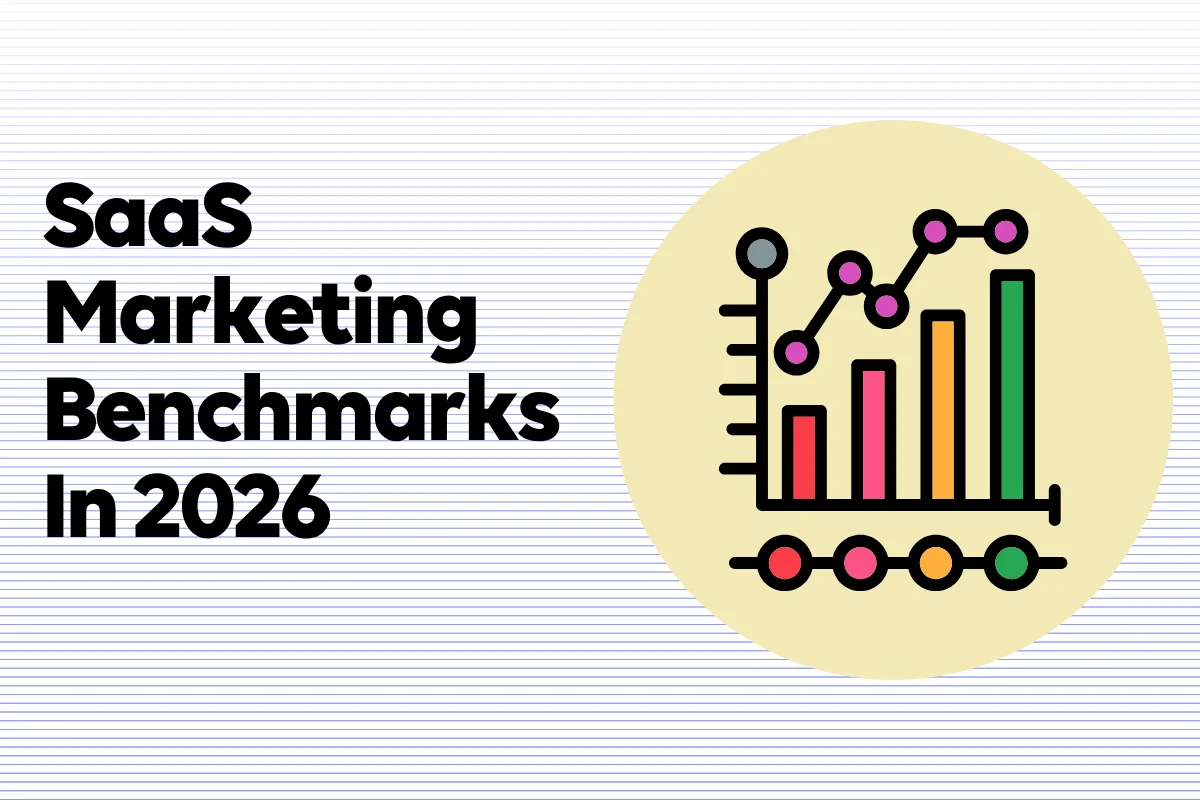
In this updated guide for 2026, we cover the latest SaaS marketing benchmarks across key channels, look at how AI is reshaping these metrics, and flag the emerging trends every SaaS marketer should be watching. Whether you work with a SaaS marketing agency or run marketing in-house, these numbers should inform your planning.
Key SaaS Marketing Benchmarks in 2026
CAC to LTV Ratio
Customer Acquisition Cost (CAC) and Lifetime Value (LTV) remain the two numbers that underpin every SaaS business model. The relationship between them tells you how much added value each customer brings, and therefore how much you can afford to spend to win them.
Current benchmarks:
- The ideal LTV:CAC ratio remains 3:1 minimum, with 4:1+ considered strong. That means for every £1 spent acquiring a customer, you should generate at least £3-4 in lifetime revenue
- The median LTV:CAC for B2B SaaS in 2025-2026 sits at 3.6:1 (Benchmarkit 2025)
- The median New CAC Ratio is now $2.00. Companies spend $2 in S&M to acquire $1 of new customer ARR, up 14% year-over-year (Benchmarkit 2025)
- CAC has risen 60% over five years and sales cycles have lengthened to an average of 134 days (up from 107 in early 2022)
CAC Payback Period:
- The median payback period is now 15-20 months (Optifai)
- Top-performing companies still achieve under 12 months
- Fourth-quartile companies are spending $2.82 per $1 of new ARR, which should be a warning sign
CAC by sales model:
- Self-serve/PLG: $100-$500
- Sales-assisted hybrid: $500-$1,200
- Enterprise sales-led: $1,200-$5,000+
- Lowest-CAC channel overall: Referrals at $141-$200
- Highest-CAC channel: Outbound sales at $1,980
One bright spot: existing customers now generate 40% of new ARR (50%+ for companies above $50M ARR), and the expansion CAC ratio of $1.00 is half the cost of acquiring new customers. If you’re not investing in expansion revenue, you’re leaving the cheapest growth on the table.
Factors to consider:
- Be patient with new investments. If you’ve recently expanded into a new region or increased spending on content marketing, these efforts take time to generate results. Don’t judge them against the same payback timeline as a Google Ads campaign.
- Read the numbers in context. A £100 CAC might look reasonable if a new customer spends £100 in year one, but without strong retention, the economics fall apart quickly. Always read CAC alongside LTV and churn.
- Get granular. Calculate CAC for each marketing channel to identify where your acquisition costs are lowest and shift budget accordingly. The difference between your best and worst channels is likely larger than you think.
Website Conversion Rates
Website conversion rate, the percentage of visitors who take a desired action, tells you how effectively your site turns traffic into pipeline.
Current benchmarks:
- Average website visitor-to-lead conversion rate for B2B SaaS: 2-3%
- Target rate with focused optimisation: 5%
- Top performers with optimised user journeys: 5-10%
- AI-native SaaS companies are seeing 56% trial-to-paid conversion versus 32% for traditional SaaS (ICONIQ 2025), which says a lot about product experience expectations
Factors to consider:
- Define what counts as a conversion. Starting a free trial or booking a demo is a stronger signal than downloading a white paper. Track both, but weight them differently. Consider breaking your benchmark into qualified leads, lead-to-trial conversions, and trial-to-paying-customer conversions.
- Watch your bounce rate. The average for B2B SaaS sits around 75%. If yours is significantly higher, your navigation and engagement need work to keep visitors moving through the funnel. (Landing pages are the exception, a high bounce rate on a focused landing page is normal.)
- Assess traffic quality. Attracting the wrong audience will tank conversion rates no matter how good your site is. This is especially relevant as AI-driven search changes the profile of who lands on your pages.
Email Marketing Performance
Despite the constant churn of new channels, email remains a reliable workhorse for B2B SaaS marketing in 2026. Privacy changes (Apple’s Mail Privacy Protection, evolving GDPR enforcement) have affected how we measure opens, but clicks still provide solid engagement data.
Current benchmarks:
- Open rates for B2B software/SaaS marketing emails: 20-25%
- Privacy features that auto-load images inflate recorded open rates (often 30%+). Treat open rates as directional, and focus on clicks and downstream actions for real engagement measurement.
- Click-through rates (CTR): 2.5-3.5% on average
- Click-to-open rate (CTOR): 10-15%, roughly one in ten opens leads to a site visit
- Email accounts for approximately 7.4% of digital marketing spend and was the only owned/earned channel to see even marginal growth in 2025 (Gartner 2025)
Factors to consider:
- If opens are strong but clicks are weak, your content isn’t compelling enough or your calls to action need sharpening. Subject lines are getting people in the door, but the email itself isn’t closing.
- Set different benchmarks for cold versus warm outreach. Cold emails will always have lower engagement than communications to an opted-in list. Comparing the two as if they’re the same channel leads to bad conclusions.
- Personalisation keeps delivering. AI-personalised send times, subject lines, and segmentation are pushing engagement rates upward. AI-generated subject lines can boost open rates by 5-15% in A/B tests. If you’re still sending the same email to your entire list, you’re leaving performance on the table.
PPC/Google Ads Performance
Paid search remains central to SaaS demand generation, but 2025-2026 has seen some sharp cost increases that every marketer needs to factor into their planning.
Current benchmarks:
- B2B non-branded search CPC hit $5.34 in 2025, up 29% year-over-year (Dreamdata, hundreds of B2B accounts)
- The WordStream/LocaliQ 2025 benchmark (16,000+ campaigns) reported an average CPC of $5.26 across all industries, with cost per lead at $70.11 (up 5.13% YoY)
- CPCs increased for 87% of industries. Google Ads costs have risen YoY for five consecutive years
- For B2B SaaS specifically, CPCs range $4-$15 depending on keyword competitiveness
- Google Search ad CTR for B2B SaaS keywords: 2-3%, with well-optimised campaigns hitting 3-5%
- B2B non-branded CTR has dropped 26% (from 5.47% to 4.04%), and the share of budgets going to non-branded search fell from 38.1% to 32.83%. Marketers are actively pulling back from expensive non-branded terms
- Conversion rate from click to lead/trial: 2-5% (average around 3%)
- Target ROAS: 3:1 to 5:1 in lifetime revenue per £1 of ad spend
LinkedIn Ads, more expensive but often worth it for B2B:
- North American SaaS CPCs now run $8-$12, with C-suite targeting pushing costs to $15-$20
- CPMs range from $31-$65 for typical B2B SaaS targeting
- Q3 has the highest CPCs at $15.72, roughly 1.5x Q1’s $10.48
- Despite the costs, LinkedIn delivers 113% ROAS ($1.13 per $1 spent) vs Google Search at 78% and Meta at 29% (Dreamdata)
- 39% of B2B marketers are increasing LinkedIn spend while reducing other platforms
- Video ads now represent 28% of all LinkedIn impressions (up from 17% in 2024)
Factors to consider:
- SaaS keywords are getting more expensive every year. Some keywords reach £80+. Google Ads often have high upfront costs, and you may lose money on customer acquisition while testing and optimising campaigns. Budget for a learning period.
- The non-branded pullback is real. With CPCs up 29% and CTRs down 26%, many B2B marketers are shifting budget from non-branded search to LinkedIn and branded terms. Consider whether your non-branded campaigns are still delivering acceptable CAC.
- LinkedIn’s cost is the price of precision. The CPCs look painful compared to Google, but the targeting and ROAS data suggest it’s often more efficient for B2B SaaS when you factor in lead quality. Test both and compare downstream conversion rates, not just CPCs.
Organic Search (SEO) Performance
Organic search still drives more traffic and leads than any other single channel for most B2B SaaS companies. But the ground is shifting under SEO in ways that demand attention.
Current benchmarks:
- Organic search typically accounts for 50%+ of SaaS website traffic, still far outpacing paid search (~15%) or social media
- The HubSpot 2026 State of Marketing Report ranked website/blog/SEO as the #1 ROI-generating channel
- SEO leads have an average 14.6% close rate (compared to just 1.7% for outbound leads)
- SERP rankings impact: Position #1 receives 28-30% of clicks, position #10 gets about 2%. Less than 1% of searchers click page 2 results
The AI search disruption:
- Gartner predicts 25% of organic search traffic will shift to AI chatbots by 2026. This is the single most important number in this article for anyone relying on SEO
- Referral traffic from ChatGPT to other websites grew 206% year-over-year (January 2025 vs January 2026), even as ChatGPT’s own traffic plateaued near a billion monthly visits (Semrush 2026)
- 92% of marketers are now optimising for both traditional and AI-powered search (HubSpot 2026)
- AI search visitors convert at 4.4x the rate of traditional organic search visitors (Semrush 2025). They arrive with clearer intent
Factors to consider:
- Long-tail keywords still deliver. Specific, intent-rich terms target users who know what they’re looking for. These visitors convert at higher rates than those arriving via broad head terms.
- Content quality beats volume. Google continues to prioritise well-written, genuinely useful content. The era of churning out average blog posts for SEO purposes is ending. AI-generated content churned out in volume without editorial oversight is increasingly penalised.
- AI search optimisation (AEO/GEO) is becoming a real budget line. The AEO services market is projected to hit $7.3 billion by 2031. Forrester recommends reallocating at least 15% of content/digital spend to improving AI search visibility. If you haven’t started thinking about how your content appears in AI answers, you’re already behind.
How AI Is Changing SaaS Marketing Benchmarks
AI has moved from “interesting experiment” to a genuine line item in marketing budgets.
AI Adoption by the Numbers
- AI and machine learning now power 24.2% of all marketing activities, nearly doubling from 13.1% in 2024 (CMO Survey/Deloitte, Spring 2026)
- 9% of total marketing budgets now go to AI tools, up from 7% in 2024, making it the fastest-growing category in marketing spend (Loopex Digital, January 2026)
- 86% of enterprise respondents said AI budgets will increase in 2026, with nearly 40% expecting increases of 10%+ (NVIDIA State of AI Report 2026, 3,200+ respondents)
- 94% of marketers plan to use AI in content creation (HubSpot 2026)
- 37.7% of marketers plan to increase investment most in AI chatbots (ChatGPT, Perplexity, etc.) in 2026. The fastest-growing investment area
- 22% of CMOs say GenAI has already reduced reliance on external agencies (Gartner 2025)
Where AI Is Improving the Numbers
Lower acquisition costs:
- AI-powered marketing solutions delivered a 37% reduction in CAC versus traditional tactics (Single Grain 2025)
- Companies using AI report up to 50% reduction in acquisition costs (Amra & Elma 2025. Treat this as aspirational, not median)
- AI-based bidding on ad platforms is generating up to 20% more conversions at similar costs
Faster, better content:
- AI enables marketing teams to produce more content without adding headcount, but the quality bar is rising as everyone gains access to the same tools
- 10.8% reduction in marketing overhead costs attributed to AI adoption (CMO Survey 2025)
- AI-generated ad copy variations can improve CTR by up to 30% versus manually written ads
Improved lead management:
- AI-driven lead scoring identifies prospects with the highest conversion likelihood
- More efficient lead prioritisation improves MQL-to-customer conversion rates
- Marketing teams are increasingly measured on lead quality, not just volume
New AI-Related Metrics to Track
Several new metrics have become standard as AI integrates deeper into marketing operations:
- AI Content Performance: Comparing engagement, conversion rates, and rankings of AI-assisted versus human-only content. Some teams track “AI Content Yield”, measuring how efficiently AI-created content translates into traffic or leads.
- GEO/AEO Visibility: How often your brand or content appears in AI-generated search results. This is fast becoming as important as traditional SERP rankings.
- Chatbot Conversion Rate: For teams using AI chatbots on-site, the percentage of bot interactions that convert to leads. Approximately 45-50% of B2B businesses now use chatbots, up from 20% a few years ago.
- Efficiency Gains: Time savings or output increases attributable to AI tools. Companies consolidating martech stacks around AI report 50-77% reductions in technology costs (ALM Corp, 2026).
Marketing Budget Benchmarks for 2026
Understanding how much to spend is just as important as knowing what metrics to target. The budget picture has stabilised, but the mix is shifting.
Overall Spend Levels
- Marketing budgets have settled at 7.7-8% of revenue, flat year-over-year and well below the pre-pandemic norm of ~11% (Gartner 2025 CMO Spend Survey, SaaS Capital 2025)
- Half of CMOs report budgets of 6% or less, underscoring a sharp divide between well-funded and lean teams
- 79.2% of marketing teams expect budget increases for 2026, with 21.2% expecting significant increases (HubSpot 2026)
- But ROI pressure is intensifying: CFO pressure on marketing is up to 63% (from 52%), CEO pressure at 61% (from 51%), and Board pressure at 50% (from 33%). The biggest jump of any stakeholder
Spend by Company Stage
| Company Stage | Marketing (% of Revenue) | Combined S&M (% of Revenue) |
|---|---|---|
| Pre-seed / Seed (<$1M ARR) | 20-40%+ | 40-95%+ |
| Early growth ($1M-$5M) | 7-15% | 25-45% |
| Growth ($5M-$20M) | 10-15% | 30-45% |
| Scale ($20M-$50M) | 8-12% | 25-35% |
| Established ($50M-$100M) | 8-12% | 25-35% |
| Public / Mature ($100M+) | 5-10% | ~33% median |
Sources: SaaS Capital 2025, Benchmarkit 2025, Data-Mania 2026
- Equity-backed companies spend 100% more on marketing and 89% more on sales than bootstrapped peers (SaaS Capital 2025)
- PLG companies allocate 13% of revenue to marketing versus 9% for sales-led and 10% for hybrid models, and grow 2x faster (High Alpha/OpenView 2025)
- AI-native startups under $1M ARR achieve 100% median growth, double the rate of horizontal SaaS peers
Channel Allocation
Paid media now takes 30.6% of total marketing budgets, up 11% year-over-year and the only category to grow its share over five consecutive years (Gartner 2025). Martech absorbs 22.4%, labour 21.9%, and agencies 20.7%. All three are declining. Digital channels account for 61.1% of total spend, the highest figure since Gartner began tracking.
| Channel | Estimated % of Marketing Budget |
|---|---|
| Paid search (Google Ads/PPC) | 10-15% |
| Paid social (LinkedIn, Meta) | 10-13% |
| Content marketing | 10-30% (varies by definition) |
| SEO | 10-15% |
| Events/conferences | 5-20% |
| Email marketing | 5-8% |
| ABM | 15-29% (enterprise B2B) |
| Martech/AI tools | 9-22% |
| Influencer/community | 2-5% |
UK-Specific Considerations
- UK B2B tech companies spend slightly more of revenue on marketing (~10%) than US counterparts (~9%)
- The UK adspend forecast for 2026 is a modest +1.5% growth (IPA Bellwether Q4 2025)
- UK marketing budgets declined in Q1 2025 for the first time in four years, rebounded in Q2-Q3, then flatlined in Q4 2025 at 0.0% net balance
- Events (+10.9%) and direct marketing (+9.7%) were the strongest-growing UK channels in late 2025
- Silicon Valley startups tend to spend more aggressively early due to VC backing, while UK startups operate leaner. As companies scale, spending levels converge between regions.
Emerging Channels and Metrics
Several developments have gained real traction since our last update:
AI-Powered Conversational Marketing
AI chatbots have become a standard fixture on B2B websites. Approximately 45-50% of B2B businesses now use them, up from 20% a few years ago. These tools capture leads that might never have completed a traditional form, and provide round-the-clock engagement that smaller teams can’t staff.
Short-Form Video
B2B SaaS marketers are increasingly using TikTok, Instagram Reels, and YouTube Shorts. 15-25% of B2B SaaS marketers now include TikTok in their strategy. These channels reach decision-makers in informal contexts where brand awareness can build without the hard sell.
Community-Led Marketing
SaaS companies building user communities on Slack, Discord, or independent forums are creating environments where prospects interact with existing customers and get value before buying. Community management has become a standard marketing function, not a nice-to-have.
AEO (Answer Engine Optimisation)
Optimising for AI-generated answers is no longer optional. The AEO services market is projected to grow from $886 million to $7.3 billion by 2031 (34% CAGR). Mid-market brands invest $75K-$150K annually in AEO programmes, while enterprise may allocate $250K+. This is the fastest-evolving area in SaaS marketing right now.
New Standard Metrics
- Marketing Qualified Accounts (MQA): Replacing or complementing MQLs, this metric looks at account-level engagement, reflecting how B2B purchasing decisions work across multiple stakeholders.
- Pipeline Velocity: How quickly leads move through the funnel by channel or content sequence. Multi-touch attribution models (often AI-powered) now connect marketing activity directly to revenue.
- Net Revenue Retention (NRR) as a Marketing Metric: Marketing teams now share responsibility for customer expansion. Metrics like “campaign-attributed expansion ARR” track marketing’s impact on growing existing accounts.
- Content Engagement Depth: Moving beyond simple views and downloads to measure actual engagement: time spent, scroll depth, interactions across formats. Performance of different content types (blogs, videos, podcasts) each carry their own KPIs.
The Link Between Marketing Spend and Growth
The data on this is clear: higher-growth companies spend approximately 40% more on marketing than lower-growth peers, and this pattern holds across both bootstrapped and equity-backed companies (SaaS Capital 2025).
Other data points worth knowing:
- Companies growing above 30% get a median of 40% of new ARR from inbound leads, compared to 30% for companies growing below 20% (Benchmarkit 2025)
- Companies with above-median growth allocate 14%+ of revenue to marketing
- The Rule of 40 remains the most reliable predictor of valuation: companies scoring above 40% are valued at 9.4x median revenue vs 3.5x for companies below 20%, a 121% valuation premium (ICONIQ 2025)
- A 1-point increase in revenue growth has nearly 2x the impact on valuation vs an equivalent increase in profit margin. Growth still commands a premium.
- Companies pairing high NRR (>120%) with low CAC nearly double their growth rates and Rule of 40 scores compared to peers with weaker retention
Marketing isn’t a cost centre. It’s the primary lever for the growth that drives SaaS valuations.
Setting Realistic SaaS Marketing Benchmarks for Your Business
With this volume of metrics available, how do you decide which ones to focus on?
Match metrics to your business stage. Early-stage companies should focus on conversion rates and channel-level CAC. Scale-ups need to watch CAC ratios and pipeline velocity. Enterprise-focused SaaS should prioritise account-based metrics and expansion revenue.
Start with industry averages, then adjust. Use the benchmarks in this article as a starting point. Your specific niche, pricing model, and target market will shift what “good” looks like. Set incremental improvement goals. Trying to leap to top-performer status in one quarter rarely works.
Recognise that metrics are interconnected. Better content quality improves both SEO and conversion rates. Lower churn improves LTV:CAC without touching acquisition spend. Looking at your metrics as a whole will reveal opportunities that any single number in isolation will miss.
Factor in the AI shift. The SaaS marketing benchmarks of 2026 are being reshaped by AI in ways that affect every channel. Companies that treat AI as a separate initiative rather than integrating it across their marketing operations will fall behind on efficiency metrics within 12 months.
Watch the budget composition, not just the total. The overall percentage of revenue spent on marketing has stabilised. The companies that are pulling ahead are the ones reallocating within that budget: shifting from agencies and labour toward AI tools, from non-branded PPC toward LinkedIn and GEO, and from new customer acquisition toward expansion revenue.
Grow Your SaaS Business with Xander Marketing
Whether you need a metrics-driven marketing strategy or hands-on support improving performance across key channels, Xander Marketing is the proven outsourced partner for B2B SaaS businesses.
With experience working with over 250 SaaS businesses since 2009, we can help you establish the right benchmarks for your business and build the campaigns to beat them. We know SaaS marketing inside out and apply both proven techniques and the latest approaches to drive results.
We’re a perfect fit for B2B SaaS businesses with no in-house marketing team, or marketing managers who need a skilled delivery partner.
Get in touch today and book your free 30-minute consultation to discuss how we can help you meet and exceed the benchmarks that will drive your SaaS business forward.