Organic traffic from SEO has declined by 20-40% across industries over the past year. Companies that dominated search for decades are watching their hard-earned traffic evaporate.
Buyers are no longer just searching, they are asking. Instead of scanning search results, they turn to AI tools like ChatGPT, Claude, Gemini and Perplexity. They ask questions directly, such as:
- What is the best project management tool for nonprofits?
- How much does [product] cost?
- Does [software] integrate with QuickBooks?
And the answers come back instantly. The problem? Unless your brand has deliberately prepared for this shift, the answer may not be yours.
When AI responds to these queries, it pulls information from its training data or wherever it finds the most citable content. That might be outdated pricing from a comparison site, feature descriptions from a 2019 review article, or security details from a generic “best of” blog.
This is where Answer Engine Optimisation (AEO) comes in - you need to have the content and be the cited source when buyers ask these questions.
What Is AEO (And Why Traditional SEO Isn’t Enough)
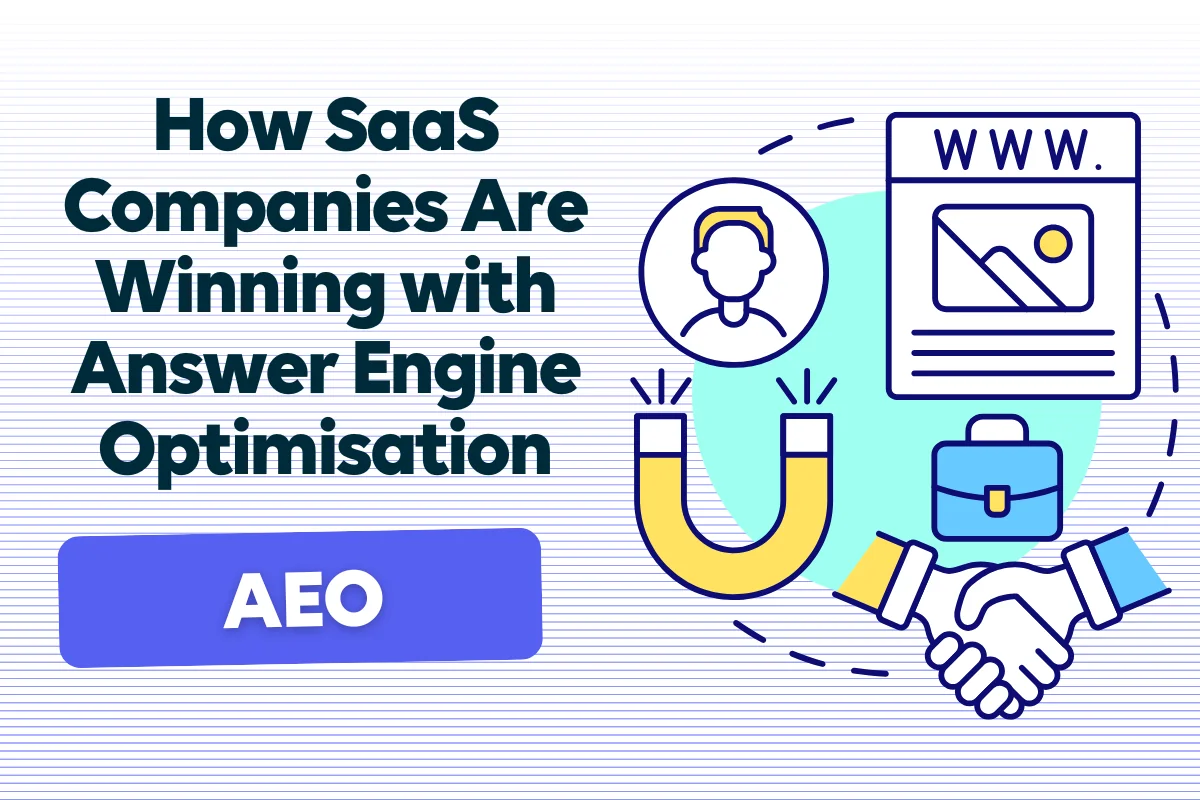
Answer Engine Optimisation (AEO) is the practice of ensuring your brand appears accurately when AI systems answer questions about your market or solution.
Think of it as SEO’s sophisticated younger sibling. Where SEO focused on ranking in Google’s results, AEO ensures you’re the answer that ChatGPT, Google’s AI Overview, Perplexity, and other AI tools give to your prospects’ crucial questions.
The stakes are massive. Organic search traffic is shifting to AI chatbots. ChatGPT alone has over 800 million weekly users. For many prospects, AI answers are their first point of research before entering your sales funnel.
Your SEO might be performing brilliantly, but ranking isn’t everything for AI visibility. When AI answers a question, it synthesises information from multiple sources to create what it believes is the most accurate response. While search rankings help with initial visibility, your perfectly optimised blog post ranking number three might get cited over the number one result if it’s better structured for AI consumption and more directly answers the question.
The Real Cost of AEO Neglect
Lost pipeline at the source: Prospects form opinions about your solution before visiting your website. If AI tells them you’re expensive or inferior to competitors, you’re fighting uphill from first contact.
Competitive disadvantage: While you focus on traditional SEO, competitors who understand AEO are defining the narrative in your category.
Trust erosion: When prospects discover discrepancies between AI responses and reality, it damages credibility.
Inefficient sales cycles: Your sales team wastes time correcting misconceptions instead of demonstrating value.
How to Build an Effective AEO Strategy
1. Get the Technical Basics Right
Enable AI crawling: Many companies block unknown web crawlers by default. Check you’re not blocking OpenAI’s SearchBot, Google’s AI crawlers, or other AI systems from accessing your content. If you’re using a blanket crawler block, explicitly whitelist these bots. If you’re not getting indexed, you can’t compete.
Track AI traffic: GA4 and major marketing platforms now show traffic from AI referrals as a separate source. Establish your baseline today and track improvements over time. Many companies are already receiving meaningful traffic from AI referrals without realising it.
Maintain SEO fundamentals: Page authority, quality backlinks, and technical optimisation still matter because AI systems often start with search results before generating answers.
2. Conduct Competitive Intelligence
Apply the “Deserve to Rank” test: For any topic you want to dominate, ask key AI platforms that exact question right now. Look at the results and sources it cites. Do you have content that honestly deserves to rank higher than what’s currently showing up? If not, create superior content first.
Multi-platform testing: Test your key queries across ChatGPT, Claude, Gemini, Perplexity, and Google’s AI mode. Document not just whether you appear, but how you’re positioned, what information is cited, and which sources are referenced.
Identify information gaps: Where is AI getting information about your company or competitors? Is it citing review sites, old articles, or direct website content? Understanding current source preferences helps predict future citation patterns.
3. Map Every Buyer Question (The Foundation of AEO)
Before restructuring existing content, you need to identify every question prospects ask during their research process. This is more comprehensive than traditional keyword research.
Direct product questions:
- “How much does [your product] cost?”
- “What features does [your product] include?”
- “Is [your product] secure?”
- “Does [your product] integrate with [specific tools]?”
Competitive comparisons:
- “[Your product] vs Competitor 1”
- “[Your product] vs Competitor 2”
- “[Your product] vs Competitor 3”
- etc.
Don’t create one generic competitors page - AI systems prefer specific, detailed comparisons for each competitor.
Use case and sizing questions:
- “Best [SaaS product] for small businesses”
- “Best [SaaS product] for enterprise”
- “Best [SaaS product] for manufacturing”
- “Best [SaaS product] for CROs”
Create separate pages for different company sizes, industries, and job roles.
Implementation and process questions:
- “How long does [your product] take to implement?”
- “How do you migrate from [competitor] to [your product]?”
- “What support do you provide?”
- “How do you onboard new users?”
Objection-handling content:
- “Is [your product] worth the cost?”
- “Do you need technical expertise to use [your product]?”
- “How reliable is [your product]?”
- “What happens if [your product] goes down?”
Each question should have its own optimised page with a clear, direct answer in the first paragraph, followed by supporting details and proof points.
4. Restructure Your Content Architecture
The biggest shift is moving from narrative blog posts designed for human readers to structured question-answer formats that AI systems can easily parse.
- Lead with answers: If someone asks “What are the best CRMs for small businesses?”, immediately provide clear factors and definitive recommendations. Don’t bury the answer in paragraph three after a storytelling hook.
- Create comprehensive FAQ sections: Build detailed FAQs addressing every possible question about your product, pricing, features, integrations, security, and comparisons. Each FAQ should be substantive enough to stand alone as a complete answer.
- Develop comparison content: Create balanced, factual comparison pages for your main competitors. AI systems often prefer comprehensive comparisons over biased sales content. Include pricing, features, use cases, and honest assessments.
- Structure for machine readability: Use clear headings as questions, keep initial answers concise (40-60 words), add FAQ and HowTo schema markup, and present information in lists and tables whenever possible.
5. Build Authority Signals
Leverage social discussion platforms: AI systems heavily index platforms like Reddit where users ask questions similar to your prospects’ queries and receive upvoted, definitive answers. Providing thoughtful, helpful responses in relevant industry discussions can pay significant dividends when AI systems reference those threads.
Establish thought leadership: Create content that demonstrates expertise through original research, case studies, and detailed technical explanations. AI systems favour authoritative sources with proven credibility.
Optimise review and reputation signals: Ensure your online reviews accurately reflect your current product capabilities and customer satisfaction levels, as AI systems increasingly factor in review sentiment when positioning brands.
6. Monitor, Measure, and Iterate
Systematic testing: Set up a process to test your key queries monthly across major AI platforms. Track changes in how you’re positioned, what information is cited, and whether your content improvements are gaining traction.
Citation tracking: Monitor not only whether you appear in AI responses, but also whether AI systems are directly citing your content. Track improvements in source attribution over time.
Conversion optimisation: Ensure that when AI systems do drive traffic to your site, those visitors can quickly complete high-value actions. Review your landing pages and conversion forms to remove friction for AI-referred visitors who may have different expectations than traditional search traffic.
The Measurable Business Impact
SasS businesses implementing comprehensive AEO strategies should see:
- Improved lead quality: Prospects arrive with accurate expectations
- Shortened sales cycles: Less time correcting misconceptions
- Enhanced competitive positioning: Key differentiators reinforced in AI responses
- Quantifiable citation growth: Measurable improvement in AI visibility
The AEO Trade-Off: Less Traffic, Better Conversions
AEO requires a fundamental shift in how you think about content and traffic:
- More content and pages: You’ll need dedicated pages for every buyer question rather than hoping one blog post ranks for multiple queries. This means creating individual comparison pages, specific use case content, and detailed FAQ sections.
- Fewer website visits: When AI answers questions directly, fewer people click through to your site. Your overall traffic numbers may initially decline as AI provides instant answers.
- Higher-converting visitors: The prospects who do visit your site after researching with AI come with serious buying intent. They’ve already consumed your key messages, understand your positioning, and are seeking deeper engagement or ready to take action.
This trade-off mirrors what happened with Google’s featured snippets: you get fewer clicks but higher-quality engagement from visitors who require more than a quick answer.
AEO Will Define Winners and Losers in Your Category
We’re still early in the AEO landscape. There’s no keyword research tool for ChatGPT yet. The competitive landscape is wide open, but not for long.
Just like the early days of SEO, businesses that move quickly will have significant advantages. The difference is that AEO might have even higher barriers to entry once it matures, given the binary nature of AI results.
Want to discover what AI is really saying about your SaaS?
Our AI Tools Readiness Audit reveals exactly how your brand is positioned across major AI platforms, identifies quick wins for immediate improvement, and provides a roadmap for long-term AEO success. Book a free consultation to discuss how our comprehensive AEO audit and action plan can be the first step on your AEO journey.
With experience working with over 200 SaaS businesses since 2009, we’re a perfect fit for B2B SaaS businesses with no in-house marketing team or marketing managers who need a skilled delivery partner.